
When it comes to summarizing complex content, choosing the right AI tool can make all the difference. TubeOnAI stands out for its versatility and ability to handle multiple formats, but how does it compare with other popular tools like Otio, QuillBot, Scribbr, scholarcy, and TLDR?
Each of these tools offers unique features tailored to different needs, whether you’re a researcher, student, or professional. Below, I discuss the key differences and similarities between these tools, helping you make an informed decision based on your specific requirements.
| Feature | TubeOnAI | QuillBot | ScribbrAI | TLDR This |
| Primary Use | Summarizes various content formats (Google Docs, PDFs, videos) | AI workspace for research and writing | Summarizes research papers and articles | Automated summarization of research papers |
| File Compatibility | Google Docs, PDFs, videos | Wide range including bookmarks, tweets, and YouTube videos | Primarily text-based content | Text-based research papers and academic content |
| Key Features | Wide range, including bookmarks, tweets, and YouTube videos | AI-generated notes, source-grounded Q&A chat, AI-assisted writing | Neural network models for precision and efficiency | Supports structuring and organizing research content |
| Ease of Use | User-friendly, straightforward interface | Section-by-section summaries support large files, handles various formats | Designed for academic users, it may require some learning | Comprehensive may have a learning curve |
| Accuracy | High accuracy with detailed summaries | Accurate, detailed AI-generated notes | High accuracy, effective for complex content | Tailored for academic precision |
| Customization | Offers detailed, customizable summaries | Highly customizable, supports deep research | Limited customization | Offers support in structuring content |
| Best For | Users need concise, accurate summaries quickly | Researchers, academics dealing with content overload | Simple, focus on efficiency | Academic researchers and writers |
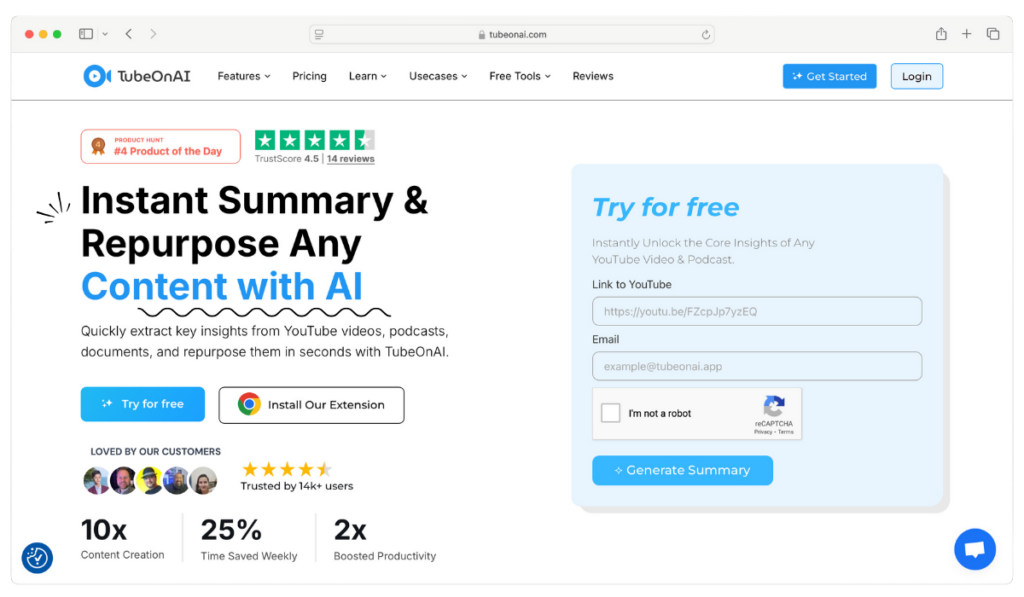
1. TubeOnAI: Best for Multi-Format Summarization
TubeOnAI is a tool that does more than summarizing text. It can also work with different file types, such as Google Docs, PDFs, and videos. It makes TubeOnAI really useful for people who want fast, accurate summaries from various sources.
TubeOnAI stands out because of its accuracy and ability to convey the main ideas in simple terms. Basic summarizers often just shorten the text, but TubeOnAI does more than that. It highlights important points, condenses the information, and presents it clearly.
Pros:
- Supports multiple formats beyond text, including videos.
- Delivers detailed, high-accuracy summaries without losing essential information.
- Simple, intuitive interface with a minimal learning curve.
- Allows customization of summary length and format based on user preference.
Cons:
- The free version has a limited number of daily summaries.
- Lacks deep integration with note-taking or citation tools.
Best For:
Students, researchers, and professionals who deal with content across multiple formats need a fast, flexible summarization tool.
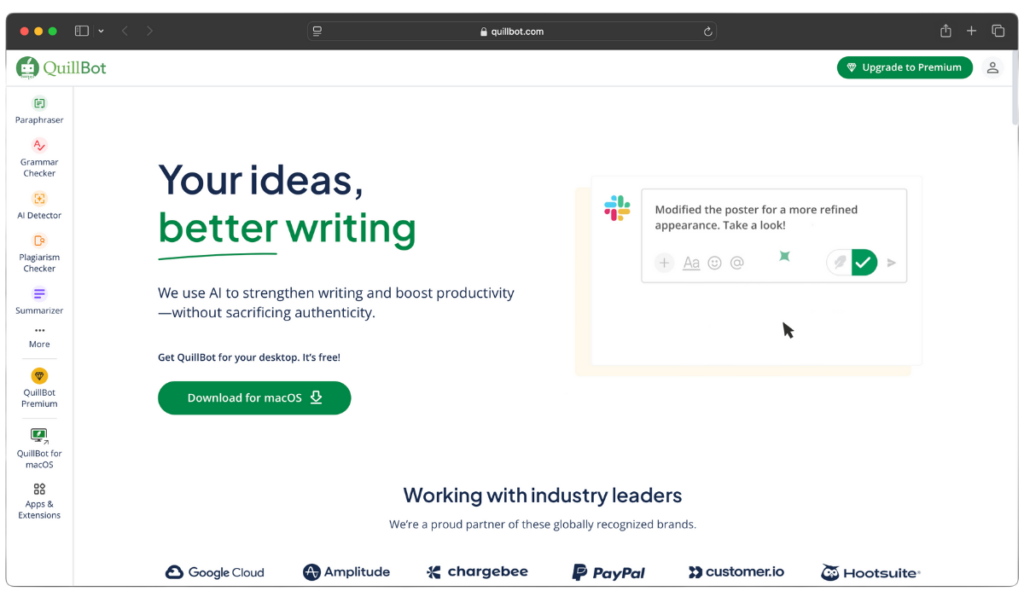
2. QuillBot: Best for Researchers & Academics
QuillBot is a smart AI tool for academic writing that goes beyond shortening text. Its features include transforming writing into different styles and tones, helping with citations, and answering questions based on sources. Because of these tools, QuillBot is popular with researchers and students who want more understanding rather than just short text versions.
Another great feature is that you can adjust the amount of detail in a summary. Depending on your needs, you can choose between a quick list of points or something more detailed. However, if this is your first time using QuillBot and you just want something fast, all the options might seem like a lot to handle.
Pros:
- Deep research capabilities beyond summarization help structure and analyze content.
- Highly customizable output to suit different reading needs.
- Integrates with citation tools, making it ideal for academic writing.
- Handles large files efficiently, reducing content overload.
Cons:
- A premium subscription is required for most of the advanced features.
Best For:
Students, PhD candidates, and researchers who need more than just summaries and require a comprehensive AI research assistant.
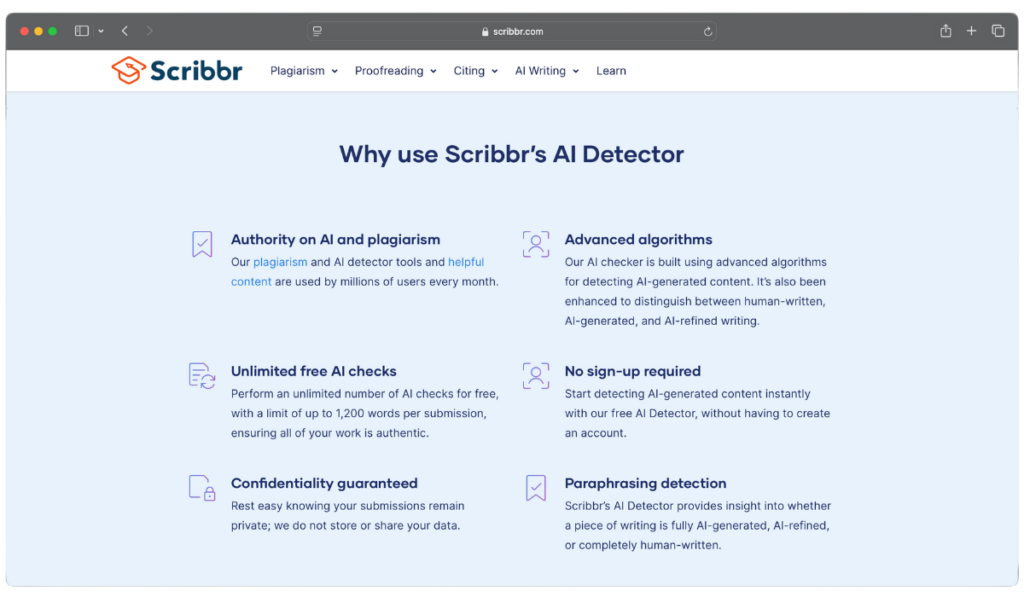
3. Scribbr AI: Best for Academic Summarization
Scribbr AI aspires to be accurate in academic work. It uses powerful artificial intelligence to ensure that research articles are summarized accurately and follow the original writing. This is extremely useful for students and academics who require reliable, well-organized summaries that retain the meaning of the original material.
The technology is simple for academic users to utilize. You can easily upload research papers and receive accurate summaries. However, unlike QuillBot, Scribbr AI does not provide many options for changing or customizing your summary. This may not be suitable for individuals who need more editorial power over how their summaries appear or are developed.
Pros:
- Highly accurate summarization with academic integrity.
- Designed specifically for students and researchers.
- Simple and clear interface with a focus on ease of use.
- Great for handling complex academic content.
Cons:
- Limited customization compared to other tools.
- The free version has word count restrictions.
Best For:
Students, academics, and researchers who prioritize accuracy and structured academic summaries over customization.
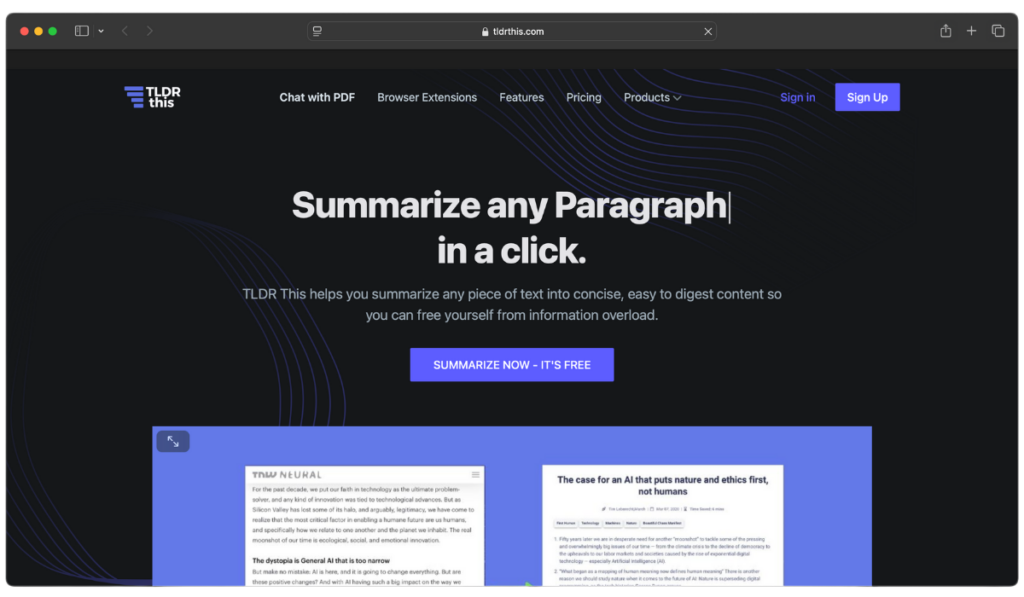
4. TLDR This
If you’re looking for a simple AI summary, TLDR is an ideal option. The application is designed for speed and efficiency, allowing users to quickly generate summaries without navigating a complicated UI. Its automation makes it suitable for quickly scanning research materials and extracting essential insights.
However, because TLDR This heavily depends on automation, it may miss important details in complex papers. While it is helpful for general understanding, it may not be appropriate for people seeking deeper insights.
Pros:
- Extremely fast and easy-to-use interface.
- Ideal for users who need quick overviews without manual tweaking.
- No sign-up is required for basic summarization.
- Good for casual reading and quick research insights.
Cons:
- Lacks customization options for summary length and structure.
- May miss crucial details in complex academic papers.
Best For:
Casual readers, professionals, and students who need quick, automatic summaries without spending time on customization.

5. Scholarcy – Best Premium tool for structuring and organizing research papers.
Scholarcy is a top-rated research organization tool. It automatically extracts and highlights key findings, references, and citations, making it invaluable for academic researchers who must structure their research effectively.
One of Scholarcy’s strengths is its ability to create structured summaries with sections such as key insights, references, and methodology. This makes it easier for users to compare and contrast multiple papers and build a solid research foundation. However, it requires some learning to utilize its structured output capabilities fully.
Pros:
- Highlights key points, citations, and methodologies.
- Allows users to create research libraries for future reference.
- Supports export options for easy citation management.
Cons:
- Requires time to master its structured output features.
- The free version has limited functionalities.
Best For:
Scholars, academics, and writers who need a tool to structure, organize, and analyze research content efficiently.
6. Elicit: Best for Summarizing Evidence Across Many Papers

Elicit helps you search and summarize scientific papers at scale. It supports AI claims with sentence-level citations, so you can check the source fast.
You can also summarize up to 40 papers into one report. This works well when you need a literature-style overview, not a single-paper recap.
Pros:
- Summarizes up to 40 papers into one report.
- Adds sentence-level citations for AI claims.
- Finds large sets of relevant papers and organizes results in tables.
- Uses a systematic review style workflow for reports.
Cons:
- Uses multi-step workflows, so it is not a one-click summary tool.
- Works best when you define clear fields and filters for your report.
Best For:
You, if you need a citation-backed summary across many papers for a review or research brief.
7. SciSpace Chat PDF: Best for Citation-Linked Summaries Inside a PDF
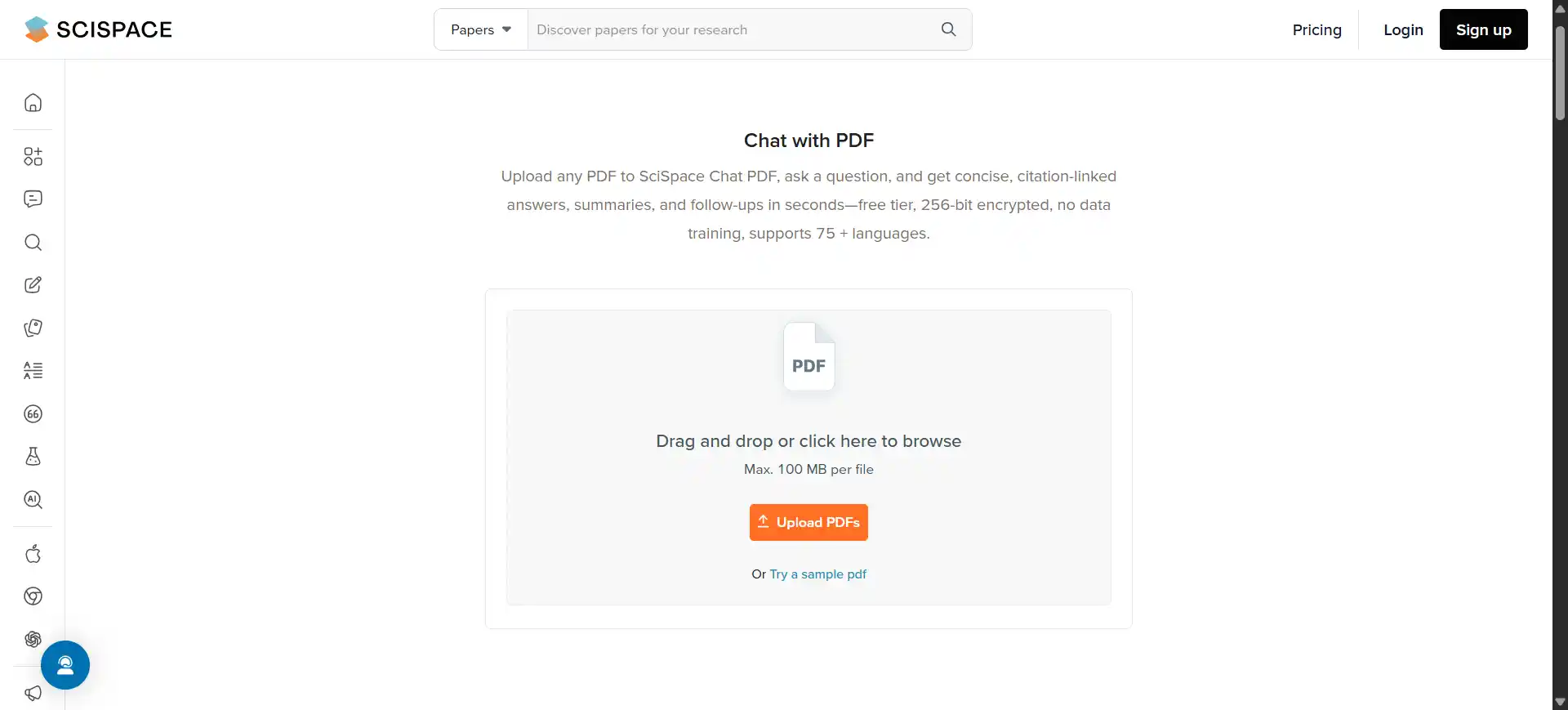
SciSpace Chat PDF lets you upload a paper and get concise summaries with citation-linked answers. It also generates a detailed, section-wise summary of your PDF.
You stay grounded in the paper because citations point to the exact sections. That makes it easier to validate the summary while you read.
Pros:
- Gives citation-backed answers from specific PDF sections.
- Creates a detailed section-wise PDF summary.
- Supports many languages and promotes strong security controls.
Cons:
- Works best with clear questions tied to a section or claim.
- Focuses on single-PDF work, not multi-paper synthesis reports.
Best For:
You, if you want fast section summaries and citation-backed answers while reading one paper.
8. Paperpal Chat PDF: Best for Summaries Plus Note Organization

Paperpal Chat PDF helps you summarize full-text research papers and understand complex topics faster. It also helps you organize notes, so you keep your learning in one place.
You get a workflow that fits literature review work. You extract key insights quickly, then store notes with references.
Pros:
- Summarizes full-text research papers.
- Helps you understand complex topics from the PDF.
- Organizes notes as part of the same tool.
Cons:
- Works best when you want a full reading workflow, not a quick paste-and-go summary.
- You still need to verify key claims inside the paper before you cite them.
Best For:
You, if you want paper summaries and organized research notes in one workflow.
9. Humata: Best for Fast Summaries of Long Technical Papers
Humata is built for long, technical PDFs. You ask it to summarize findings, compare documents, and search for answers across your files.
You use it like a research assistant for reading. This helps when you need to extract the core result fast and move on.
Pros:
- Summarizes findings from long technical papers.
- Supports document comparison and cross-file search.
- Targets scientific studies and research-style documents.
Cons:
- You get better output when you ask specific questions about results or methods.
- It is a reading tool, so you still need to judge what is citation-worthy.
Best For:
You, if you read long PDFs and want quick, targeted summaries and answers
So, Which AI Tool Should I Choose to Summarize Research Papers?
TubeOnAI is the best AI summarizing tool for summarizing various types of content, including research papers. It supports summarizing PDFs, Google Docs, and other file types, making it versatile for academic and professional use.
While several tools offer impressive capabilities, TubeOnAI stands out as the best choice due to its unique advantages. Here’s why TubeOnAI is the superior option:
1. Versatility Across Multiple Formats
Unlike other tools that primarily focus on text-based content, TubeOnAI can handle a variety of formats including Google Docs, PDFs, and even videos.
This versatility makes it an all-in-one solution for summarizing research papers and other complex documents, ensuring that you can use it across different types of content without switching tools.
2. Section-by-Section Summaries
TubeOnAI excels in providing detailed, section-by-section breakdowns of your documents, a feature that is particularly beneficial for lengthy and complex research papers.
While tools like TLDR offer quick overviews, they lack the depth that TubeOnAI provides, making it easier for users to focus on the most important sections of their work.
3. User-Friendly Interface
TubeOnAI’s interface is designed with ease of use in mind, allowing both beginners and advanced users to navigate and operate the tool effortlessly.
While other tools may offer a comprehensive suite of features, they often come with a steeper learning curve, which can slow down your workflow. TubeOnAI strikes the perfect balance between functionality and usability.
4. Accuracy and Customization
While many AI summarization tools are accurate, TubeOnAI goes a step further by allowing users to customize their summaries to focus on specific details or sections.
This level of control ensures that the summaries generated are not only precise but also tailored to your exact needs, something that tools like AI Summarizer or TLDR might not offer.
5. Handling Large Files with Ease
One of the challenges researchers often face is dealing with large, complex documents. TubeOnAI is built to handle these with ease, breaking them down into manageable sections without losing any critical information.
This capability sets it apart from other tools, which may struggle with processing large files or might oversimplify the content.
6. Comprehensive Solutions for Professionals and Students
TubeOnAI’s ability to support diverse content formats, deliver in-depth summaries, and maintain a user-friendly experience makes it the best tool for both professionals and students.
Whether you’re working on a detailed research paper, summarizing multiple articles, or extracting key points from a long video lecture, TubeOnAI provides everything you need in one package.
Also Read: Best Podcast Summary Generator
Who Can be Benefited from Summarizing Research Paper
Summarizing research papers is helpful for many people, especially those who need to quickly understand complex information. It allows students, researchers, and professionals to grasp the key points of a study without reading the entire paper.
1. Students and Academics: Students and scholars can save time by quickly grasping the key points of complex studies. This allows them to focus on critical analysis and further research rather than getting bogged down in lengthy texts.
2. Researchers: Researchers often need to review numerous papers to stay updated in their field. Summaries help them efficiently scan through relevant literature to identify the most pertinent studies for their work.
3. Professionals: Professionals in fields like medicine, engineering, and technology use research to inform their practice. Summaries provide them with the necessary insights without requiring them to read through full papers.
4. Journalists and Writers: Those in media and publishing can use summaries to quickly understand scientific findings and convey them to a broader audience, making complex topics more accessible.
5. Policy Makers: Summaries allow policymakers to make informed decisions by distilling research findings into actionable insights, enabling them to apply evidence-based knowledge to real-world issues.
Final Thoughts
Using AI for research paper summarization can help you study and work more efficiently, keeping you educated without reading too much. AI-powered research paper summarization tools have transformed the way we consume research papers. These tools can help you save time and improve your ability to understand.
Each summarizer in our list offers unique advantages. Ultimately, the best AI summarizer depends on your specific needs. TubeOnAI is your best choice if you require versatility and accuracy across multiple formats.
If you’re looking for a research assistant rather than just a summarizer, QuillBot is a strong contender. Academic users might prefer Scribbr AI or Scholarcy, while those prioritizing speed and simplicity may find TLDR This sufficient.
