Science YouTube Channels That Teach, Not Just Entertain
Science YouTube channels sorted by subject and level, with who each is for, where to start and which ones still upload.

Updated
The best science YouTube channels depend on what you want to learn and how much you already know. For big-picture curiosity, start with Veritasium, Kurzgesagt and SciShow. For physics and space, MinutePhysics is the easy entry point and PBS Space Time the deep end. For chemistry, NileRed and Periodic Videos. For biology and Earth science, PBS Eons and MinuteEarth. For math, 3Blue1Brown. And if you’re studying for a class, Crash Course, Amoeba Sisters and Professor Dave Explains follow the syllabus more closely.
Learning science isn’t intimidating anymore with the help of YouTube. Animations, real experiments and expert storytelling make it easier to understand complex laws and formulas. Below are 36 channels sorted by subject, each with who it’s for and its level. We checked every channel in October 2026 to see what it posts now and how often, and we list two finished channels separately as archives. All of them make learning easier without costing anything. Looking for channels across all subjects, not just science? See our list of educational YouTube channels for adults.
Quick Picks by Subject and Level
| Channel | Subject | Level | Uploads (checked Oct 2026) |
|---|---|---|---|
| Veritasium | Physics, engineering, how we know things | Beginner to intermediate | Every week or two |
| SmarterEveryDay | Engineering and slow-motion experiments | Beginner | Every 1–3 months |
| Mark Rober | Engineering projects and challenges | Beginner | Every 1–3 months |
| Kurzgesagt | Animated overviews of everything | Beginner | Several a month |
| SciShow | Quick answers and new research | Beginner | Several a week |
| MinutePhysics | Short physics explainers | Beginner | Every month or two |
| PBS Space Time | Astrophysics and quantum physics | Advanced | Every week or two |
| Kyle Hill | Nuclear science and physics stories | Beginner to intermediate | A few a month |
| Vsauce | Big questions across science and philosophy | Beginner | Rare (archive is the draw) |
| Steve Mould | Everyday physics with demonstrations | Beginner | About monthly |
| Arvin Ash | Physics and cosmology in about 15 minutes | Intermediate | About monthly |
| Dr. Becky | Astrophysics and space news | Intermediate | Weekly |
| Anton Petrov | Daily science and space news | Beginner to intermediate | Almost daily |
| Stuff Made Here | Engineering builds | Beginner | Every few months |
| Practical Engineering | Civil engineering and infrastructure | Beginner | Twice a month |
| Marques Brownlee | The tech inside gadgets | Beginner | Weekly |
| Linus Tech Tips | Computer hardware | Beginner | Several a week |
| NileRed | Chemistry experiments | Intermediate | Rare (big projects) |
| Periodic Videos | Chemistry and the elements | Beginner | Every month or two |
| The Thought Emporium | DIY biology and chemistry | Intermediate | About monthly |
| TierZoo | Animal adaptations, game-style | Beginner | Every few months |
| Ben G Thomas | Paleontology and evolution | Beginner to intermediate | About monthly |
| PBS Eons | History of life on Earth | Beginner to intermediate | Every week or two |
| Brave Wilderness | Wildlife and animal behaviour | Beginner (family) | Weekly |
| MinuteEarth | Earth science, ecology, animals | Beginner | Weekly |
| 3Blue1Brown | Visual math, from calculus to neural networks | Intermediate | Every month or two |
| Numberphile | Math ideas explained by mathematicians | Beginner to intermediate | Weekly |
| Stand-up Maths | Math puzzles and real-world math | Beginner | A few a month |
| Andrew Huberman | Neuroscience and health (podcast) | Intermediate | Weekly or more |
| Medlife Crisis | Medicine and health myths | Beginner | A few a month |
| Crash Course | Full science courses | Beginner (high school, college intro) | Weekly (other subjects) |
| Amoeba Sisters | High school biology | Beginner | About monthly |
| Professor Dave Explains | Chemistry, biology, physics tutorials | Beginner to intermediate | Several a week |
| The Organic Chemistry Tutor | Chemistry, physics and math practice problems | Beginner to intermediate | Rare (huge library) |
| SciShow Psych | Psychology | Beginner | Archive (last video 2022) |
| Journey to the Microcosmos | Microscopic life | Beginner | Archive (ended Oct 2024) |
General Science
These channels cover a wide range of topics, from physics to biology to engineering. They break complex formulas or laws into understandable and exciting ideas, which makes them the best place to start.
Veritasium
Best for: curious adults who like a surprising question and a real experiment.
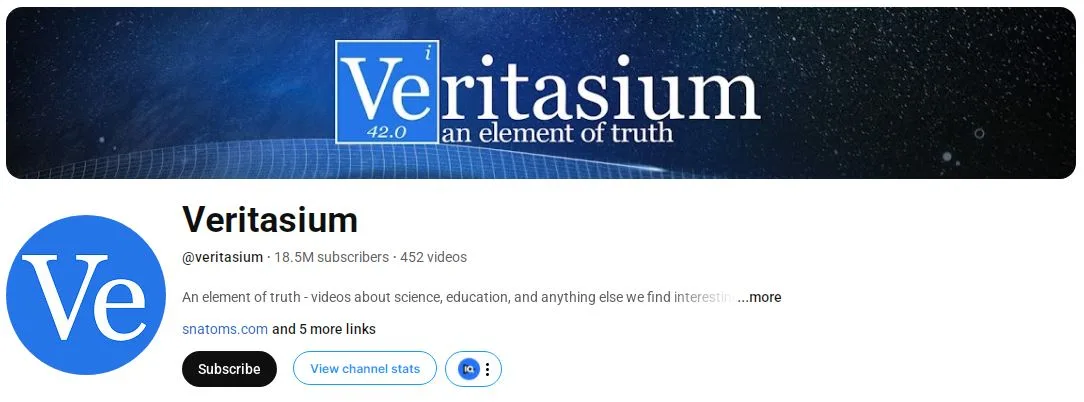
Physicist Derek Muller created this channel, Veritasium. It is one of the most popular science channels on YouTube. He explains tricky ideas in physics, engineering, and everyday life through experiments, interviews, and thought-provoking questions.
Videos like ‘The Illusion of Truth’ challenge viewers to rethink what they know, while recent ones such as ‘The Insane Engineering of Fiber Optics’ dig into how modern technology works.
Veritasium makes even complex scientific concepts easy to understand with simple visuals and clear explanations. If you want to read the key points of a video before you watch it, we keep a page of Veritasium video summaries.
SmarterEveryDay
Best for: people who learn best by watching things happen in slow motion.
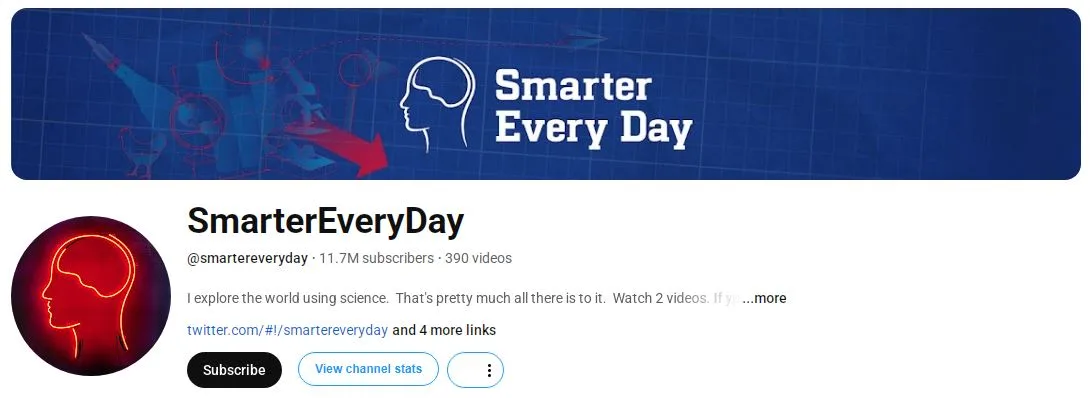
Aerospace engineer Destin Sandlin runs this channel. SmarterEveryDay is all about looking at the world with curiosity. Destin uses slow-motion cameras and hands-on experiments to explore things like how helicopters fly, why cats always land on their feet, or what happens inside a nuclear reactor core. Episodes come out every one to three months, and they’re worth the wait.
Mark Rober
Best for: families and beginners who want engineering made fun.
Former NASA engineer Mark Rober mixes science with creativity and fun. His channel is full of clever inventions, huge experiments, and viral pranks. Recent videos lean toward big challenges and stunts, such as solving board games or outsmarting car thieves.
Behind the humor and excitement, his videos provide real engineering lessons, explained in a simple way that anyone can follow. Mark’s videos prove that science is not just a serious thing; it can also be playful, inspiring, and full of joy.
Kurzgesagt – In a Nutshell
Best for: visual learners who want a beautiful, short overview of a big topic.
Based in Germany, Kurzgesagt creates some of the most beautiful animated science videos online. Their short, colorful explainers cover big topics like black holes, climate change, human biology, and even philosophy. Every video turns complicated ideas into clear, engaging stories. Kurzgesagt tries to show in every video that science can be both visually stunning and fun at the same time.
SciShow
Best for: quick, frequent answers to odd science questions and new research.
SciShow, from the team behind Crash Course, explores “the scientific subjects that defy our expectations,” with Hank Green among its hosts. Several short videos come out every week, on everything from cloning to how you could hold something at 10 million degrees. It’s the fastest way to keep a steady stream of science in your feed.
Physics & Space
For those who look up at the night sky with wonder or question the fundamental laws of reality, these channels offer mind-bending explorations of physics and the cosmos. They’re listed roughly from easiest to most demanding.
MinutePhysics
Best for: beginners who want a quick, clear explanation without heavy math.
If you want to learn physics quickly and clearly, MinutePhysics is an excellent choice. Using simple hand-drawn animations, the channel breaks down complicated topics such as quantum mechanics, relativity, or the physics of time. Most videos are short and easy to follow.
Steve Mould
Best for: seeing everyday physics with your own eyes.
Steve Mould builds clever demonstrations of strange physical effects, such as a pump that seems to work like perpetual motion or a device that turns anything into a suction cup, and then explains exactly why they work. It’s a great channel for building intuition, not just collecting facts.
Kyle Hill
Best for: people who like science told as a true story.
Kyle Hill is the channel where science meets storytelling. Cool, right?
His recent videos focus on nuclear accidents and radiation incidents, plus the stranger edges of physics and thought experiments, like quantum immortality. Kyle explains how the science works behind real-world disasters, and his energetic style and ability to mix fun with facts make science feel fresh and accessible to everyone.
Vsauce
Best for: big questions that mix science, philosophy and psychology.
Hosted by Michael Stevens, Vsauce is one of the most influential educational channels on YouTube. Each video usually begins with a simple question like ‘What is the speed of dark?’ or ‘Why do we dream?’ After that, he expands these questions into a fascinating mix of science, philosophy, psychology, and history. New uploads are rare now (the latest was in July 2025, after a gap of about three years), but the archive is still one of the best on YouTube.

Anton Petrov
Best for: daily science and space news.
Anton Petrov posts almost every day about new discoveries in space, physics, biology and chemistry, often the same week a study comes out. He uses simulations and plain language, so it’s a good channel for staying current between deeper videos.
Dr. Becky
Best for: astronomy fans who want to know how we know things.
Dr. Becky Smethurst is an astrophysicist at the University of Oxford. Her channel explains black holes, galaxies and new discoveries, and focuses on how scientists know what they know. Her monthly Night Sky News episodes are an easy way to keep up with astronomy.
Arvin Ash
Best for: the step between beginner explainers and PBS Space Time.
Arvin Ash answers big questions in physics and cosmology, from extra dimensions to whether physicists missed a fifth force, in videos of about 15 minutes. He uses animations and simple analogies, so you get more depth than a quick explainer without needing the math.
PBS Space Time
Best for: viewers with some background who want university-level physics.
For those who love space and want a deeper challenge, PBS Space Time goes beyond the basics. This channel is hosted by astrophysicist Matt O’Dowd. It explores advanced topics in astrophysics and cosmology like black holes, dark matter, and the nature of time itself. How Matt explains complex things with passion and clarity makes you feel like you’re sitting in on a university lecture. But obviously, the one that’s engaging and visually supported by great animations.
Engineering & Technology
These channels are for those who are fascinated by how things are made or how modern technology works.
Stuff Made Here
Best for: watching the engineering design process, mistakes included.
Stuff Made Here is all about big, ambitious engineering projects. The host, Shane, takes wild ideas like a haircutting robot or an automatic pool stick and builds them. What makes the channel special is not just the final invention, but also the step-by-step problem-solving process. Viewers get to see the challenges, mistakes, and clever fixes along the way. New videos only arrive every few months now.
Practical Engineering
Best for: understanding the infrastructure around you.
Civil engineer Grady Hillhouse hosts, writes and produces Practical Engineering, which explains dams, bridges, roads, power and water systems, and why they sometimes fail. New videos come out on the first and third Tuesday of each month.
Marques Brownlee (MKBHD)
Best for: the technology side of science.
This channel is best known as one of YouTube’s top tech reviewers. Marques Brownlee (MKBHD) is mainly a gadget reviewer, not a science channel, but his explanations of things like smartphone cameras, batteries and displays help viewers appreciate the engineering that makes devices work.
Linus Tech Tips
Best for: learning how computer hardware works.
Linus Tech Tips is one of the biggest technology channels on YouTube. It’s famous for computer builds and product reviews, and it also explains the science behind hardware and electronics in a way that’s fun and accessible, for example by testing graphics cards and CPUs.

Chemistry
These channels are the best choice for learners who want to understand chemistry in a fun and engaging way.
NileRed
Best for: seeing real lab chemistry done step by step.
This channel is very beneficial for chemistry enthusiasts. NileRed conducts a huge variety of fascinating chemical reactions, like synthesizing unique compounds or turning everyday materials into something unexpected (recent projects include turning air into alcohol). All these complicated matters are explained in visual form. Big projects take time, so new videos come only a few times a year.
Periodic Videos
Best for: beginners who want to meet the elements one by one.
A collaboration with the University of Nottingham, this channel features a video for every single element on the periodic table, and it still adds new ones, such as an updated video on iron. It’s a comprehensive and charming exploration of the building blocks of our universe.
The Thought Emporium
Best for: DIY science fans who like ambitious experiments.
This channel focuses on DIY biology and chemistry projects at the frontier of science. It explores topics like genetic engineering, material science, and bio-hacking in a home lab setting.
Biology, Nature & Earth
Explore the incredible diversity of life on Earth, from the smallest microbes to the largest animals, and delve into the epic history of evolution. (For human history rather than natural history, see our list of history channels on YouTube.)
TierZoo
Best for: gamers and anyone who likes a creative angle.
This unique channel analyzes animals as if they were characters in a video game, ranking their “builds,” “stats,” and “abilities” based on evolutionary biology. It’s a brilliantly creative way to learn about animal adaptations.
Ben G Thomas
Best for: paleontology and prehistoric life.
If you’re fascinated by paleontology and prehistoric life, this is the channel for you. Ben creates well-researched video essays on dinosaurs, ancient ecosystems, and the evolution of life on Earth, including a series checking the scientific accuracy of the documentary Walking With Beasts.
PBS Eons
Best for: deep time and evolution, explained clearly.
This channel takes you on a journey through deep time to explore the epic history of life. With beautiful illustrations and clear narration, you’ll learn about mass extinctions, bizarre ancient creatures, and our own evolutionary story.
Brave Wilderness
Best for: families who like their biology up close.
Hosted by Coyote Peterson, this channel gets you up close and personal with wildlife. While famous for enduring painful stings and bites, the videos are filled with educational content about animal behavior and biology.
MinuteEarth
Best for: short, illustrated Earth science and ecology.
From the team that started MinutePhysics, MinuteEarth explains “science and stories about our awesome planet” with hand-drawn animation: why some sunsets are better than others, where we might find aliens, how sea turtles survive. Videos are short, so it’s good for beginners and younger learners too.
Mathematics
Math is the language of the universe, and these channels prove it can be beautiful, intuitive, and fascinating, not just a series of dry equations.
3Blue1Brown
Best for: anyone who wants to see math, not just read about it.
3Blue1Brown, created by Grant Sanderson, is perfect for anyone who wants to see math, not just read about it. Using custom animations, Grant makes complex topics like calculus, linear algebra, and neural networks visually clear and intuitive. Start with the Essence of calculus or Essence of linear algebra series.
Numberphile
Best for: math ideas explained by the mathematicians who work on them.
Numberphile dives into the fascinating world of numbers. The channel features interviews with mathematicians and explains topics from prime numbers and probability to infinity and unusual patterns in math. Numberphile makes math feel exciting, approachable, and full of surprises for viewers of all levels.
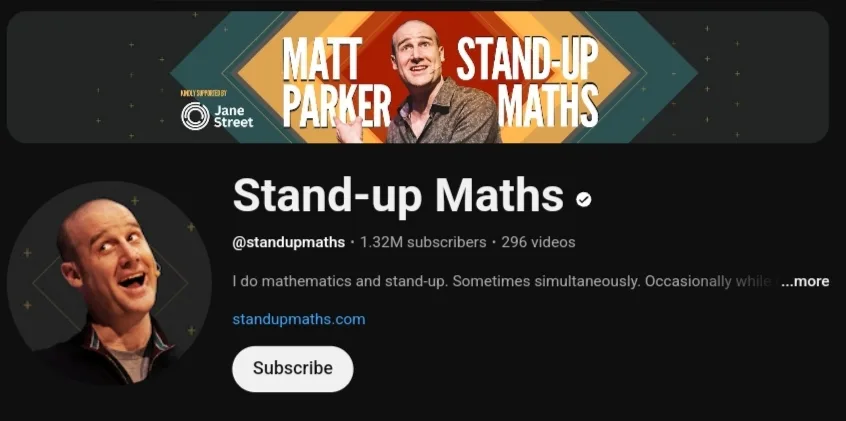
Stand-up Maths
Best for: fun, real-world math.
Hosted by mathematician and comedian Matt Parker, Stand-up Maths makes math entertaining and easy to understand. Matt explores quirky math topics in everyday life, such as testing another YouTuber’s “15,000%” claim or the maths of the TV show The Traitors. His approach shows that math isn’t just about numbers; it can be fun, surprising, and deeply connected to the real world.
Psychology & Health
Understand the most complex machine of all: the human brain. These channels explore the science of our minds, behavior, and health.
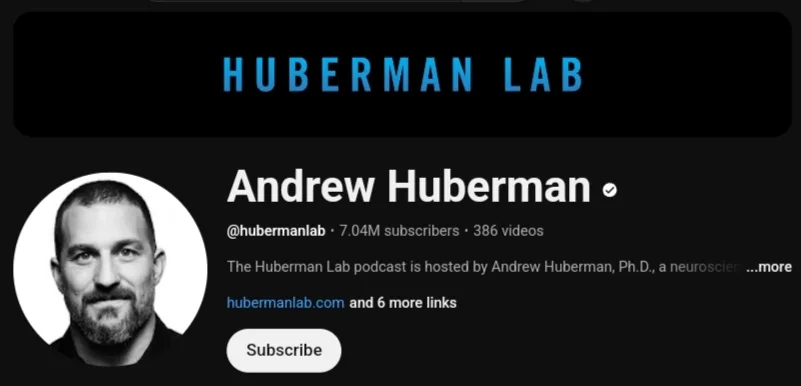
Andrew Huberman
Best for: long-form conversations about neuroscience and health.
Andrew Huberman, an associate professor of neurobiology at Stanford School of Medicine, hosts the Huberman Lab podcast. Episodes dive deep into topics such as brain function, sleep, stress, and focus, and include tools he recommends for health and performance. Some scientists have criticised the show for promoting poorly regulated supplements and for stating early research with more certainty than it supports, so treat specific health advice as a starting point to check with a doctor. Episodes are long; our Huberman Lab episode summaries give you the key points first.
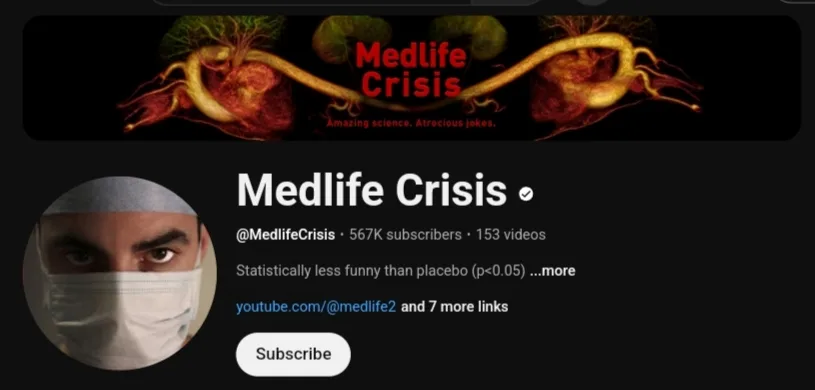
Medlife Crisis
Best for: medical science with a sense of humor.
Cardiologist Dr. Rohin Francis runs Medlife Crisis, a channel that uses humor and wit to explain medical science. He debunks common myths, discusses unusual medical cases, and critiques misinformation in the media. By combining sharp insights with lighthearted storytelling, Medlife Crisis makes learning about medicine engaging, accurate, and fun.
For Students: Courses and Exam Help
If you’re studying science for school or an exam, these channels follow course topics more closely than the entertainment-first channels above.
Crash Course
Best for: a full course in one subject, in order.
Crash Course runs complete courses in short episodes. For science, start with the Biology, Chemistry, Physics or Astronomy playlists. A new Geology course was still running in October 2026.
Amoeba Sisters
Best for: high school biology.
Two sisters, one a former high school biology teacher, explain topics like DNA, meiosis and cell biology with cartoons and humor. They update older videos (a new meiosis video came out in 2026) and also make comics and other resources for teachers and students.
Professor Dave Explains
Best for: clear tutorials in chemistry, biology and physics.
Professor Dave, who has a BA in chemistry and did graduate studies in synthetic organic chemistry and science education, has built a huge library of short tutorials on general and organic chemistry, biology, physics and more. The channel also posts debunking videos and other subjects, so use the playlists to stay on topic.
The Organic Chemistry Tutor
Best for: worked practice problems before a test.
Despite the name, this channel covers general and organic chemistry, physics, algebra, precalculus and calculus, mostly as step-by-step worked examples. New uploads are rare (the latest was in March 2026), but the existing library is so large that most standard topics are already covered.
Archives Still Worth Watching
These channels no longer upload, but their videos are still accurate and useful.
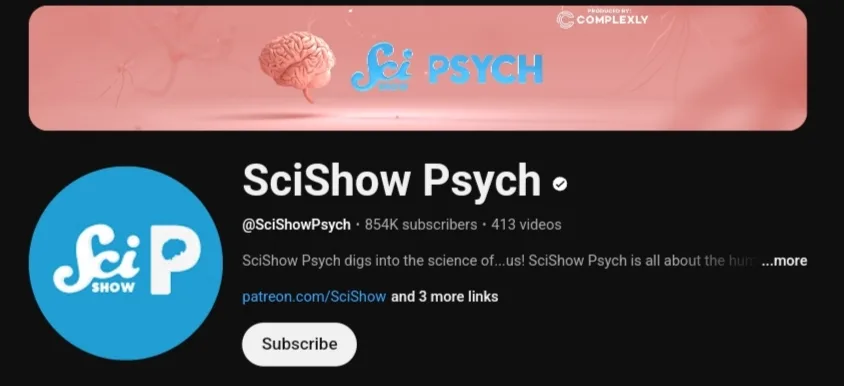
SciShow Psych
SciShow Psych, created by the team behind SciShow, focuses on psychology and human behavior. The channel answers questions about why people think, feel, and act the way they do, covering topics from social dynamics to mental health. It stopped posting in 2022, so treat it as a library of short, clear psychology explainers.
Journey to the Microcosmos
Hosted by Hank Green and Deboki Chakravarti, this channel films microscopic life up close and reflects on what it means. Its final video, “The Future of Microscopy (and end of our Journey),” came out in October 2024, but the whole series is still available.
How to Learn More From Science Videos
- Pick one subject and go in order. Use a course playlist (Crash Course, 3Blue1Brown’s “Essence of” series) instead of jumping between random videos.
- Climb the levels. In physics, for example, start with MinutePhysics, move to Arvin Ash, then try PBS Space Time.
- Keep notes. Pause to write down the main idea of each video in one or two sentences. For long lectures, reading a summary first shows you which parts to watch closely.
- Check what matters. For anything you’ll use in an essay or for your health, look for the study or source behind the claim.
FAQs
Are these YouTube channels scientifically accurate?
Most of these channels are known for careful research, and many are hosted by experts like PhDs, engineers, or medical professionals or involve consultations with specialists. That said, accuracy varies, and health advice in particular deserves extra care. It’s always good to stay critical and cross-check information, especially if you’re using it for academic or professional purposes.
What are the best science YouTube channels for adults?
For adults who want depth rather than kid-friendly explainers, try Veritasium, PBS Space Time, Arvin Ash, Dr. Becky, 3Blue1Brown, Practical Engineering and Medlife Crisis. Kurzgesagt and SciShow are lighter but still well researched.
Can I learn complex subjects just from YouTube?
YouTube is a fantastic tool to supplement learning. However, for in-depth mastery or a professional career, it’s best to combine videos with structured learning like textbooks, formal courses, and hands-on practice.
How do I choose the right channel for me?
It depends on your learning style. If you enjoy stunning animations, try Kurzgesagt. If you like hands-on experiments, check out SmarterEveryDay or Steve Mould. For deep, podcast-style discussions, Andrew Huberman is the best known. The easiest way is to sample a few videos from different channels and see which style clicks with you.
Do I need prior knowledge to follow these channels?
Not necessarily. Many channels, like MinutePhysics, SciShow and MinuteEarth, start with the basics. However, channels like PBS Space Time or 3Blue1Brown can be challenging if you have no prior background. You can always watch introductory videos first to get up to speed.
How often do these channels post new content?
Posting frequency varies a lot. Anton Petrov posts almost daily, SciShow and Linus Tech Tips several times a week, and Numberphile, MinuteEarth and Dr. Becky about weekly. Project-heavy channels like NileRed and Stuff Made Here can go months between videos. The table above shows what we found in October 2026. It’s best to subscribe and turn on notifications for your favorites; TubeOnAI’s channel subscriptions can also summarize new videos from the channels you follow automatically.